What Is a Plot Mountain and How Do You Use It to Plan a Story?
What Is a Plot Mountain?
Every story has a shape. It starts slowly, gets more exciting, reaches a big moment, and then settles down. A plot mountain shows that shape as a picture.
A plot mountain is a drawing of a story that looks like a hill. You climb up on one side, reach the top, and walk down the other side. Each part of the climb matches a part of the story.
You may also see it called a plot diagram, story mountain, or plot structure chart. These names mean almost the same thing. Teachers use it in class, and writers use it to plan their own stories.
The Five Parts of a Plot Mountain
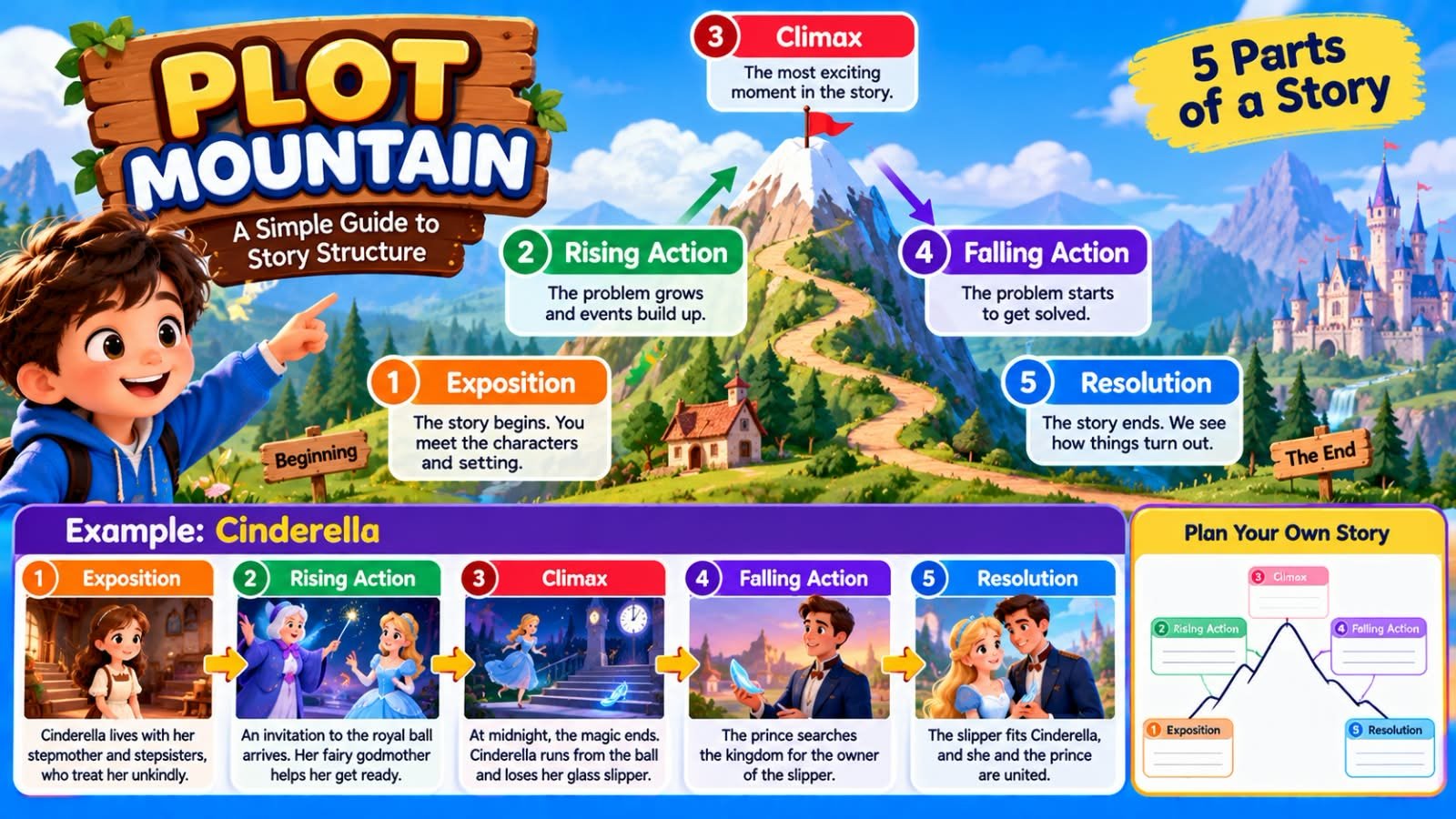
1. Exposition. This is the bottom of the mountain on the left. The story begins here. You meet the main characters and learn where and when the story takes place.
2. Rising action. The path now goes up. A problem appears, and events build on each other. This is usually the longest part of the story.
3. Climax. This is the top of the mountain. It is the most exciting or tense moment, where the main problem reaches its peak.
4. Falling action. The path goes down. The problem starts to get solved, and the story slows down.
5. Resolution. This is the bottom on the right. The story ends, and we see how things turned out for the characters.
Some teachers add a sixth part called conflict (the main problem), and some writers add an inciting incident, the event that starts the trouble. The five-part version is the one most students learn first.
Where Did the Plot Diagram Come From?
The idea is linked to Gustav Freytag, a German writer who lived in the 1800s. He studied the shape of stories and described how a drama rises to a turning point and then falls. His pyramid shape is the base of the plot diagram used in schools today. A plot mountain is just a smoother, friendlier version of it.
Plot Mountain Example: Cinderella
An example makes it much easier. Here is the classic story of Cinderella.
- Exposition: Cinderella lives with her stepmother and stepsisters, who treat her unkindly.
- Rising action: An invitation to the royal ball arrives. Cinderella cannot go at first, but her fairy godmother helps her get ready.
- Climax: At midnight, the magic ends. Cinderella runs from the ball and loses her glass slipper.
- Falling action: The prince searches the kingdom for the owner of the slipper.
- Resolution: The slipper fits Cinderella, and she and the prince are united.
Try this with any story you know, such as The Three Little Pigs. It works for books, movies and even cartoons.
How to Make Your Own Plot Mountain
You only need a pencil and paper.
- Draw a hill shape with a flat line at the bottom.
- Write the five part names at the right places: exposition at the left base, climax at the top, resolution at the right base.
- Think of a story you have read or want to write.
- Fill in one or two short sentences for each part.
- Check the shape. Does the tension grow before the top? Does the ending feel complete?
If you do not want to draw, a blank plot mountain template or printable worksheet does the same job. Many free ones are available online.
Tips for Students and Teachers
- Start with a short story, like a fable or a picture book, before trying a long novel.
- Keep each note brief. A few words are enough.
- Ask one question at each part: “What just happened?” and “What might happen next?”
- Do not worry if a story does not fit perfectly. Some stories are more complicated, and that is fine.
Why a Plot Mountain Helps
It makes a story easy to see on one page. Students can understand what they read, and young writers can plan a clear beginning, middle and end. It also helps you notice when a story has no real high point, which is a common reason a story feels flat.
Frequently Asked Questions
Is a plot mountain the same as a plot diagram?
Yes, in most classrooms. Both show the main events of a story in order.
How many parts does a plot mountain have?
Most have five: exposition, rising action, climax, falling action and resolution.
Which grade learns it?
It is mostly taught in elementary and middle school, but writers of any age can use it.
Can I use it for a movie?
Yes. Any story with a beginning, a problem and an ending can be mapped.
Final Thoughts
A plot mountain is a simple way to see how a story is built. Once you can draw one, you can read stories more closely and write better ones. Pick a story you love and map it today.
Explore More: