
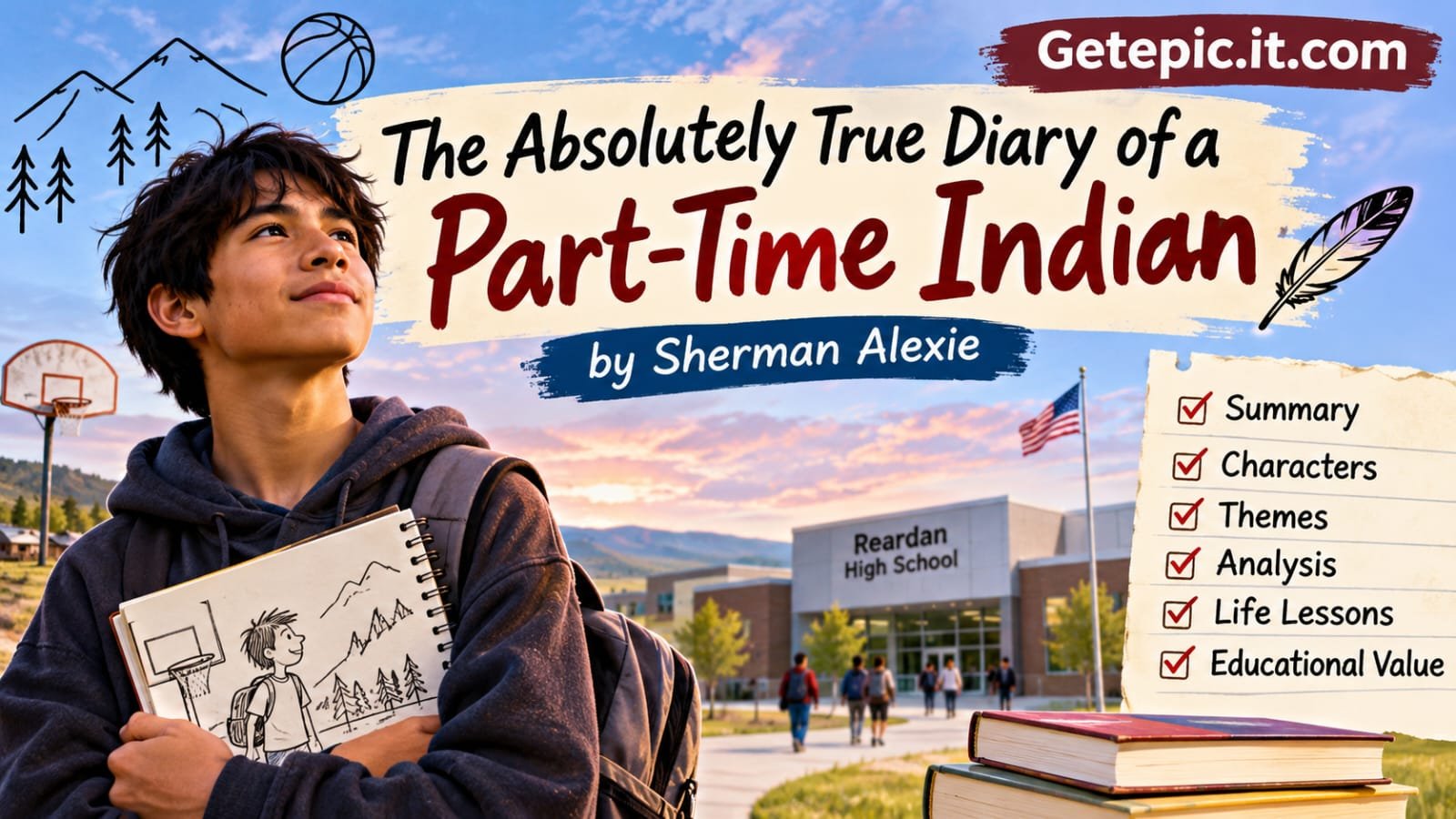
Alexie Part-Time Indian: Complete Book Analysis and Summary
What happens when a teenager leaves the school and community he has always known to look for a better future somewhere else? This is the central question in The Absolutely True Diary of a Part-Time Indian, a young adult novel by Sherman Alexie.
First published in 2007, the book follows Arnold Spirit Jr., a Native American teenager who lives on the Spokane Indian Reservation in Washington. Most people call him Junior. He is interested in drawing cartoons, learning new things, and building a future beyond the limits he sees around him.
Junior makes a difficult decision when he leaves his reservation school and starts attending Reardan High School, a mostly white school outside his community. His choice creates problems with old friends and introduces him to a new group of classmates who do not always understand his background.
The novel uses humor, personal memories, and illustrations to explore education, friendship, poverty, racism, family, and cultural identity. It also shows how difficult it can be to change your life without losing your connection to the people and places that helped shape you.
This guide explains the book’s story, important characters, major themes, and educational value in clear English. It is useful for students, teachers, parents, and readers who want to understand Sherman Alexie’s novel more deeply.
What Is The Absolutely True Diary of a Part-Time Indian About?
The Absolutely True Diary of a Part-Time Indian is a coming-of-age novel about a teenager trying to find his place in two different communities.
The main character, Arnold Spirit Jr., grows up on the Spokane Indian Reservation. His life is affected by poverty, limited educational opportunities, family problems, and the way other people judge him.
He is also a talented cartoonist. Drawing helps him express thoughts and feelings that he sometimes finds difficult to explain in words.
After an important conversation with his teacher, Mr. P, Junior begins to think differently about his future. He decides to leave his reservation school and attend Reardan High School, where he hopes to receive a better education.
However, the move is not easy. Junior becomes an outsider in his new school because he is Native American, while some people in his old community believe he has turned his back on them.
The story follows his efforts to manage these changes while dealing with friendship, school life, personal loss, and questions about who he really is.
The book is written as a diary, so readers experience many events through Junior’s own thoughts. His drawings also add another layer to the storytelling.
The Story of Arnold Spirit Jr.: A Detailed Summary
Junior’s Early Life on the Reservation
Arnold Spirit Jr. lives with his family on the Spokane Indian Reservation in Wellpinit, Washington. His childhood is not easy. He has several physical health problems and has often been bullied because of his appearance.
He is intelligent and curious, but he does not always feel accepted by the people around him. His closest friend is Rowdy, a boy who understands his difficult life and often protects him.
Junior enjoys drawing cartoons. For him, art is more than a hobby. It gives him a way to explain his experiences, dreams, and frustrations.
His school life is also difficult. The reservation school has limited resources, and Junior begins to feel that staying there will make it harder for him to reach his goals.
One incident involving an old geometry textbook makes him especially aware of how little has changed in his school. It becomes one of the events that pushes him to question the education he is receiving.
The Decision to Attend Reardan High School
Junior’s teacher, Mr. P, recognizes that he has the ability to build a different future. Their conversation encourages Junior to think beyond the situation he has always known.
Junior eventually decides to attend Reardan High School, a school outside the reservation with a predominantly white student population.
The decision requires courage because he knows that people in his community may not understand it.
His best friend Rowdy feels deeply hurt. He sees Junior’s decision as a betrayal, and their friendship becomes strained.
Junior now has to manage two very different environments. At home, some people question his loyalty to his community. At Reardan, he must deal with classmates who have little experience with his background.
Adjusting to a New School
Starting at Reardan brings both challenges and opportunities.
Junior is initially treated differently because he is the only Native American student at the school. Some classmates are curious about him, while others make assumptions based on stereotypes.
However, he gradually develops relationships with people who see him as an individual.
Two important characters in his new school life are Penelope and Gordy. Penelope becomes an important friend and love interest, while Gordy encourages Junior to take his education seriously and explore ideas through reading and discussion.
Junior also discovers that he can succeed academically and become a stronger basketball player.
These experiences help him gain confidence, but they do not remove the difficulties he faces outside school.
Family Problems and Personal Loss
Junior’s journey is not only about changing schools. His family also experiences serious hardships.
Poverty, alcoholism, and personal loss affect his home life. He has to face events that are emotionally difficult for someone his age.
The deaths of people close to him make him think about family, community, and the unfair situations that many people experience.
Alexie does not present Junior as someone who always knows what to do. He makes mistakes, feels confused, and sometimes struggles to understand his own emotions.
That is one reason the character feels realistic. He is a teenager trying to make sense of a complicated world.
Basketball and the Meaning of Friendship
Basketball becomes another important part of Junior’s experience at Reardan.
Playing against his former school creates a difficult situation because he must compete against people he grew up with, including Rowdy.
The games represent more than winning or losing. They show the emotional distance that has developed between the two friends.
Junior’s success at Reardan does not mean he has forgotten where he comes from. Instead, he is learning that he can pursue new opportunities while still caring about his family, culture, and community.
By the end of the novel, Junior begins to understand that identity does not have to fit into only one category.
Who Are the Main Characters in Part-Time Indian?
The characters help explain the different pressures Junior experiences as he grows up. Each person has an important role in his understanding of friendship, family, education, and identity.
Arnold Spirit Jr. (Junior)
Arnold Spirit Jr. is the main character and narrator. He is a teenager from the Spokane Indian Reservation who wants a better education and more opportunities.
He enjoys drawing cartoons and uses humor to deal with uncomfortable situations. Although he is intelligent, he often struggles with confidence and acceptance.
His decision to attend Reardan shows that he is willing to take risks for his future, even when other people disagree with him.
Rowdy
Rowdy is Junior’s childhood best friend. He is strong, aggressive, and protective, but he also has personal problems.
He understands Junior better than most people because they have grown up together. However, he feels abandoned when Junior leaves their reservation school.
Their changing friendship shows how personal growth can sometimes create distance between people who once shared everything.
Mr. P
Mr. P is Junior’s teacher at the reservation school. He recognizes Junior’s intelligence and encourages him to look for opportunities outside the environment he knows.
His advice becomes an important turning point in the story because it helps Junior imagine a different future.
Penelope
Penelope is a student at Reardan and becomes close to Junior. Their relationship helps him feel more comfortable at his new school.
She also has personal struggles, which reminds readers that people can face difficulties even when their lives appear comfortable from the outside.
Gordy
Gordy is one of Junior’s classmates at Reardan. He is interested in learning and encourages Junior to think carefully about books and ideas.
Their friendship helps Junior develop his confidence as a student.
Junior’s Family
Junior’s parents and other family members influence his decisions and emotional development. They face financial and personal challenges, but family connections remain an important part of his life.
Their experiences help readers understand the difficult circumstances surrounding Junior’s childhood.
Major Themes in The Absolutely True Diary of a Part-Time Indian
The novel covers several important subjects that are useful for classroom discussions and literary analysis. These themes are connected to Junior’s experiences rather than being separate ideas.
1. Identity and Belonging
Identity is one of the most important themes in the novel.
Junior feels that he does not fully belong at either of the schools and communities in his life. At the reservation, some people question his decision to attend Reardan. At his new school, he is seen as different because of his Native American background.
This creates a difficult question: Can a person belong to more than one community?
Junior gradually learns that his identity is not decided by the school he attends or the opinions of other people. He can be proud of his heritage while also choosing a different path for his future.
Real example from the story: Junior continues to care about Rowdy and his reservation community even after he begins making friends at Reardan.
2. Education and Opportunity
Education is another central theme.
Junior believes that attending Reardan will give him access to better opportunities. His decision shows how important a supportive school environment can be for a young person’s development.
The contrast between the two schools also raises questions about unequal educational resources.
For example, Junior becomes aware that the textbook used at his reservation school is extremely old. This incident makes him think about the difference between the education he receives and the opportunities available elsewhere.
The book encourages students to consider why every child should have access to quality education, regardless of their background or income.
3. Friendship and Loyalty
Junior and Rowdy’s friendship changes throughout the story.
At first, they share a close relationship built on trust and their experiences growing up together. But when Junior leaves the reservation school, Rowdy feels that his friend has rejected him.
Their conflict shows that friendship can become complicated when people make different choices.
The novel also shows that loyalty does not always mean making the same decisions as your friends. Sometimes, people need space to follow their own goals.
4. Poverty and Social Inequality
Poverty affects many parts of Junior’s life.
His family has limited financial resources, and the reservation community faces problems connected to unemployment and a lack of opportunities.
The novel shows how these conditions can affect education, personal choices, and family relationships.
Junior’s experiences also remind readers that poverty is not simply a personal failure. It can be connected to larger social and economic conditions.
Teachers can use this theme to encourage students to discuss equal opportunities and the importance of community support.
5. Racism and Stereotypes
Junior experiences prejudice because of his Native American identity.
Some people at Reardan do not understand his background, while others make assumptions about him before getting to know him.
The story shows how stereotypes can affect relationships and make people feel excluded.
It also encourages readers to look beyond labels. Junior is not defined by one part of his identity. He is a student, an artist, a friend, a family member, and a person with his own ambitions.
6. Hope and Personal Growth
Despite the difficulties in his life, Junior continues to look for opportunities.
He experiences rejection, grief, and disappointment, but he does not give up on his education or his interest in art.
His progress is not perfect or simple. He has moments of fear and uncertainty, which makes his development more believable.
The message is that personal growth often happens through difficult experiences, not only through success.
Why Is the Book Called Part-Time Indian?
The title refers to Junior’s complicated experience of living between two different communities.
He is a Spokane Indian teenager who attends a predominantly white school outside the reservation. Some people in his original community see his decision as leaving behind his culture, while his classmates at Reardan see him as different because of his background.
The phrase “part-time Indian” reflects the conflict he feels about belonging and identity.
However, the novel does not suggest that Junior can simply stop being part of his culture. Instead, it explores the pressure he experiences when other people expect him to fit into one fixed idea of who he should be.
The title is important because it connects the entire story to the question of identity.
Sherman Alexie and the Background of the Novel
Sherman Alexie is an American writer known for exploring Native American life, family relationships, identity, and social challenges in his work.
He grew up on the Spokane Indian Reservation in Wellpinit, Washington. Some parts of his personal background influenced the experiences presented in The Absolutely True Diary of a Part-Time Indian.
The novel is semi-autobiographical, meaning that it draws on elements of the author’s life but tells a fictional story through the character of Arnold Spirit Jr.
The book also includes illustrations by Ellen Forney. These drawings are an important part of the reading experience because Junior is a cartoonist who often uses pictures to express his feelings.
The novel won the 2007 National Book Award for Young People’s Literature. It became an important work in young adult literature because of its direct storytelling, humor, and discussion of difficult social issues.
Final Thoughts
The Absolutely True Diary of a Part-Time Indian is more than a story about a teenager changing schools. It explores what happens when a young person wants to create a different future while remaining connected to family, friendship, and cultural background.
Junior’s experiences show that education can open new doors, but personal growth also brings difficult decisions. His relationship with Rowdy, his adjustment to Reardan, and his experiences at home all help readers understand the challenges of growing up.
For students, the novel offers useful opportunities to study character development, first-person narration, symbolism, and major literary themes. For teachers, it provides a starting point for discussions about identity, equal educational opportunities, and cultural understanding.
Its lasting value comes from the questions it raises about belonging and the freedom to choose your own future.



One Comment