Super Phonics Jog Jog Jog (og): Song & Words
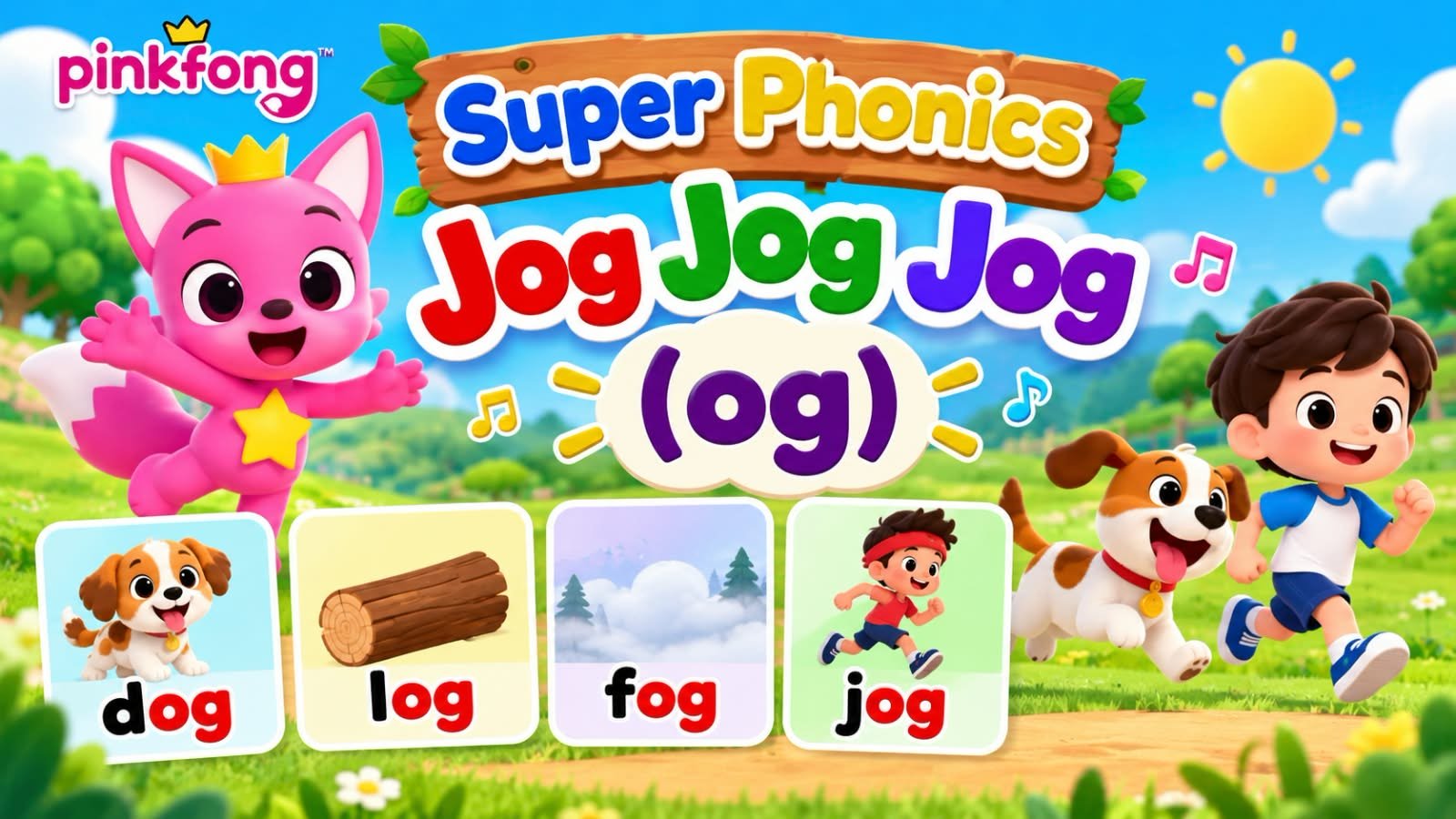
Super Phonics – Jog Jog Jog (og) is a children’s phonics song created by Pinkfong. It introduces young learners to the “og” word family through music, repetition, and simple English sounds. The video is listed on Epic’s digital reading platform for children, with a recommended age range of 0–4 years.
If you’re looking for the Jog Jog Jog song, want to understand the “og” sound, or need easy phonics activities for preschoolers, this guide explains what you need to know.
Children can use songs like this as part of early reading practice. Parents and teachers can also introduce simple words such as dog, log, fog, and jog to help children recognise common letter patterns.
What Is Super Phonics – Jog Jog Jog (og)?
Super Phonics – Jog Jog Jog (og) is an educational phonics video by Pinkfong. It belongs to the Super Phonics series, which introduces children to English sounds and spelling patterns through songs.
The official Epic listing identifies Pinkfong as the creator and gives the video a recommended age range of 0–4 years.
The “og” in the title refers to a group of words that share the same ending letters. Examples include dog, log, fog, and jog.
Children can listen to the song and then practise reading these words with an adult. This approach combines listening with letter recognition and spoken language practice.
Video details
- Title: Super Phonics – Jog Jog Jog (og)
- Creator: Pinkfong
- Category: Children’s educational music and phonics
- Learning focus: The “-og” word family
- Recommended age on Epic: 0–4 years
- Available on: Epic and YouTube, subject to the availability of the relevant listing
You can visit the official Epic video page for the listing and access information.
Watch Jog Jog Jog by Pinkfong
Parents and teachers can use the song as a starting point for a short phonics lesson. Let children listen first, then repeat the words and identify their sounds.
Watch the song on YouTube:
The linked YouTube entry is titled “Jog Jog Jog” and appears on Pinkfong’s official artist channel as an auto-generated music release. It lists the song under Super Phonics Songs.
For the video version titled “Super Phonics – Jog Jog Jog (og),” you can also visit the Epic listing.
What Is the “-og” Word Family?
A word family is a group of words that share a common spelling pattern and often a similar ending sound.
The “-og” word family contains words that end with the letters o and g. When children learn this pattern, they can practise reading several words by recognising the shared ending.
For example:
| Word | Simple meaning |
|---|---|
| Dog | An animal that is often kept as a pet |
| Log | A cut piece of a tree trunk |
| Fog | A cloud of tiny water droplets near the ground |
| Jog | To run at a gentle, steady pace |
| Hog | A pig, especially a large one |
| Bog | Wet, soft ground |
| Frog | A small animal with long back legs that can jump |
| Clog | To block or obstruct something |
These examples are useful for early vocabulary practice. Some words, such as frog, contain an extra consonant at the beginning, so children may need more practice blending the sounds.
How Does the “-og” Pattern Work?
Consider the word dog.
- The letter d represents the first sound.
- The letters og form the ending.
- Blending the sounds produces the spoken word “dog.”
Children can practise the same pattern with other words.
For example:
- d + og = dog
- l + og = log
- f + og = fog
- j + og = jog
This is a simple way to introduce blending, the process of combining individual speech sounds to read a word.
Pronunciation can vary between English accents. The key learning point is to recognise the spelling pattern and practise the words aloud.
What Can Children Learn From Jog Jog Jog?
The song can support several early literacy skills when combined with adult guidance and reading activities.
1. Letter and Sound Recognition
Young children begin learning that written letters represent sounds in spoken language. Practising the “-og” ending helps them notice a recurring spelling pattern.
2. Early Reading and Blending
Children can practise combining a beginning consonant with the “og” ending. Start with short words such as dog and log before introducing more challenging examples.
3. Vocabulary Development
Learning words in a group gives children opportunities to connect spelling, pronunciation, meaning, and pictures.
For instance, a picture of a dog can help a child connect the printed word with a familiar animal.
4. Listening and Speaking
Songs provide opportunities to listen carefully, repeat sounds, and practise speaking. Adults can pause after a word and encourage children to say it themselves.
A song is a useful learning aid, but it should not replace regular reading, conversation, or age-appropriate phonics instruction.
Easy “-og” Phonics Activities for Parents and Teachers
You don’t need special equipment to practise the “-og” word family. A few pictures, paper, and five minutes of focused practice can be enough for a short activity.
Activity 1: Read the Words Aloud
Write dog, log, fog, and jog on a sheet of paper.
Point to each word and say it slowly. Ask the child to repeat it, then identify the letters shared by all four words.
Keep the activity relaxed. Repeat the words that are difficult and praise the child for trying.
Activity 2: Match Words With Pictures
Draw or print pictures of a dog, a log, and fog. Write the matching words underneath or on separate cards.
Ask the child to match each word with its picture.
This activity connects written vocabulary with meaning and encourages children to look carefully at the letters.
Activity 3: Find the Missing Letter
Write these incomplete words:
- _og
- d_g
- l_g
- f_g
Ask the child to complete each word with the missing letter.
You can make the activity easier by providing the letters d, l, and f as choices.
Activity 4: Make a Word Family Chart
Create a small chart with “-og” at the top. Add words such as dog, log, fog, jog, and hog.
Let children draw a picture beside each word. Display the chart where they can revisit it during reading practice.
Activity 5: Listen, Pause, and Repeat
Play the Jog Jog Jog song and invite the child to repeat familiar sounds or words.
After listening, ask simple questions such as:
- Which word ends with “og”?
- Can you read the word dog?
- What other word has the same ending?
Adapt the questions to the child’s age and reading ability.
Other Pinkfong Super Phonics Songs to Explore
Children who enjoy Jog Jog Jog may also like other videos from the Super Phonics series.
Epic’s phonics collections list several related titles, including:
| Song title | Letter pattern |
|---|---|
| Super Phonics – Big Pig | -ig |
| Super Phonics – Fin in Bin | -in |
| Super Phonics – Pam Jam Jam | -am |
| Super Phonics – I Met a Vet | -et |
| Super Phonics – Dan in a Van | -an |
| Super Phonics – Pop Pop Poppity Pop | -op |
| Super Phonics – Tad is Sad | -ad |
These songs focus on different spelling patterns. Parents and teachers can choose one pattern at a time, then help children practise the words they hear.
Explore the official Epic Phonics collection to see the listed videos and other phonics resources.
Where Can You Find the Jog Jog Jog Song?
There are two useful places to start.
Epic: The official Super Phonics – Jog Jog Jog (og) page provides information about the video. Access may depend on the platform’s current account and eligibility requirements.
YouTube: The Jog Jog Jog music entry is available on Pinkfong’s official artist channel as an auto-generated music release. You can use YouTube to listen to the song and check the current availability of the relevant video version.
If you’re a parent, you can play the song and follow it with a short reading activity. Teachers can use the “-og” word family as part of a broader phonics lesson.
If you publish an article about this song, link to the original official sources rather than presenting the song as your own creation. Re-uploading Pinkfong’s original audio or video requires appropriate rights or permission.
Frequently Asked Questions
What is Jog Jog Jog (og)?
Jog Jog Jog (og) is a phonics song created by Pinkfong. It is listed on Epic as part of the Super Phonics series and focuses on the “-og” spelling pattern, which appears in words such as dog, log, fog, and jog.
What age is Super Phonics – Jog Jog Jog suitable for?
Epic lists the video for ages 0–4. Parents and teachers should still consider each child’s attention span, language development, and early reading skills when choosing activities.
What does “og” mean in phonics?
The letters “og” form a common ending in words such as dog, log, fog, and jog. Children can learn to recognise this pattern and blend it with beginning consonants to read simple words.
Is Jog Jog Jog available on YouTube?
A music entry titled “Jog Jog Jog” is available on Pinkfong’s official artist channel. You can listen on YouTube. Availability of a particular video version may differ from the music release.
What words belong to the “-og” word family?
Examples include dog, log, fog, jog, hog, bog, and clog. Frog also shares the “-og” ending, although it has a consonant blend at the beginning.
How can parents teach the “-og” word family?
Start with a few simple words, say each one aloud, and point out the shared ending. Use pictures, matching cards, and short reading exercises to help children connect the letters with their sounds and meanings.
What other Super Phonics songs can children watch?
Epic’s phonics collection lists related titles such as Big Pig (ig), Fin in Bin (in), Pam Jam Jam (am), I Met a Vet (et), and Dan in a Van (an). These provide additional examples of common spelling patterns.
Conclusion
Super Phonics – Jog Jog Jog (og) by Pinkfong is a useful starting point for introducing young children to the “-og” word family. With words such as dog, log, fog, and jog, parents and teachers can combine music with simple reading, vocabulary, and sound-blending activities.
For the original listing, visit Epic. To listen to the available music release, visit Pinkfong’s official YouTube artist channel. Follow the song with a short practice activity so children can apply what they hear to written words.